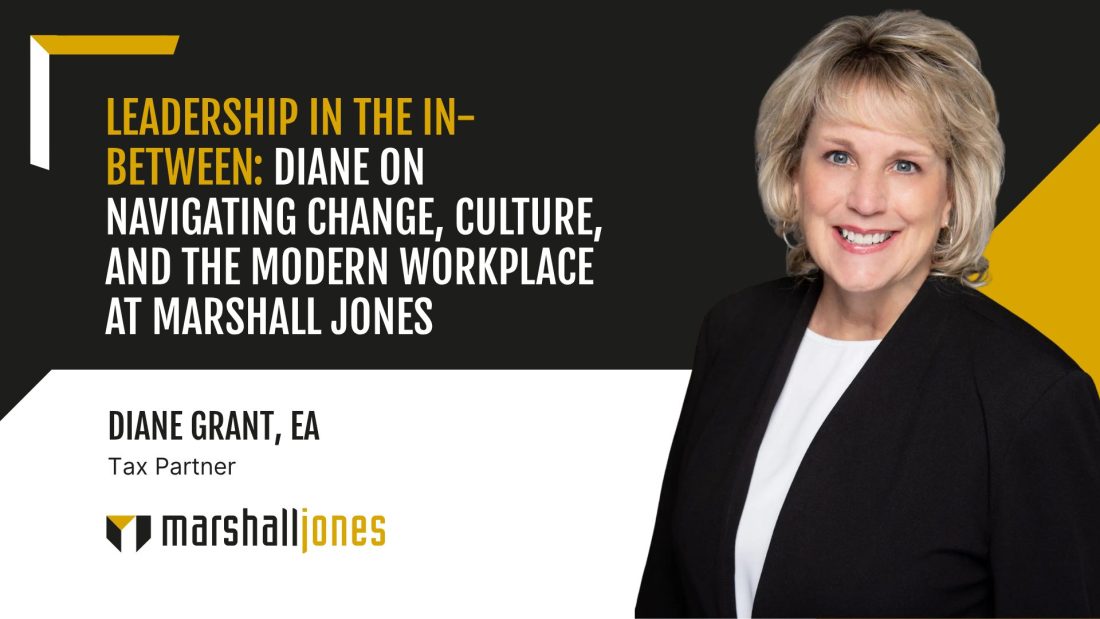
Leadership in the In-Between: Diane on Navigating Change, Culture, and the Modern Workplace at Marshall Jones
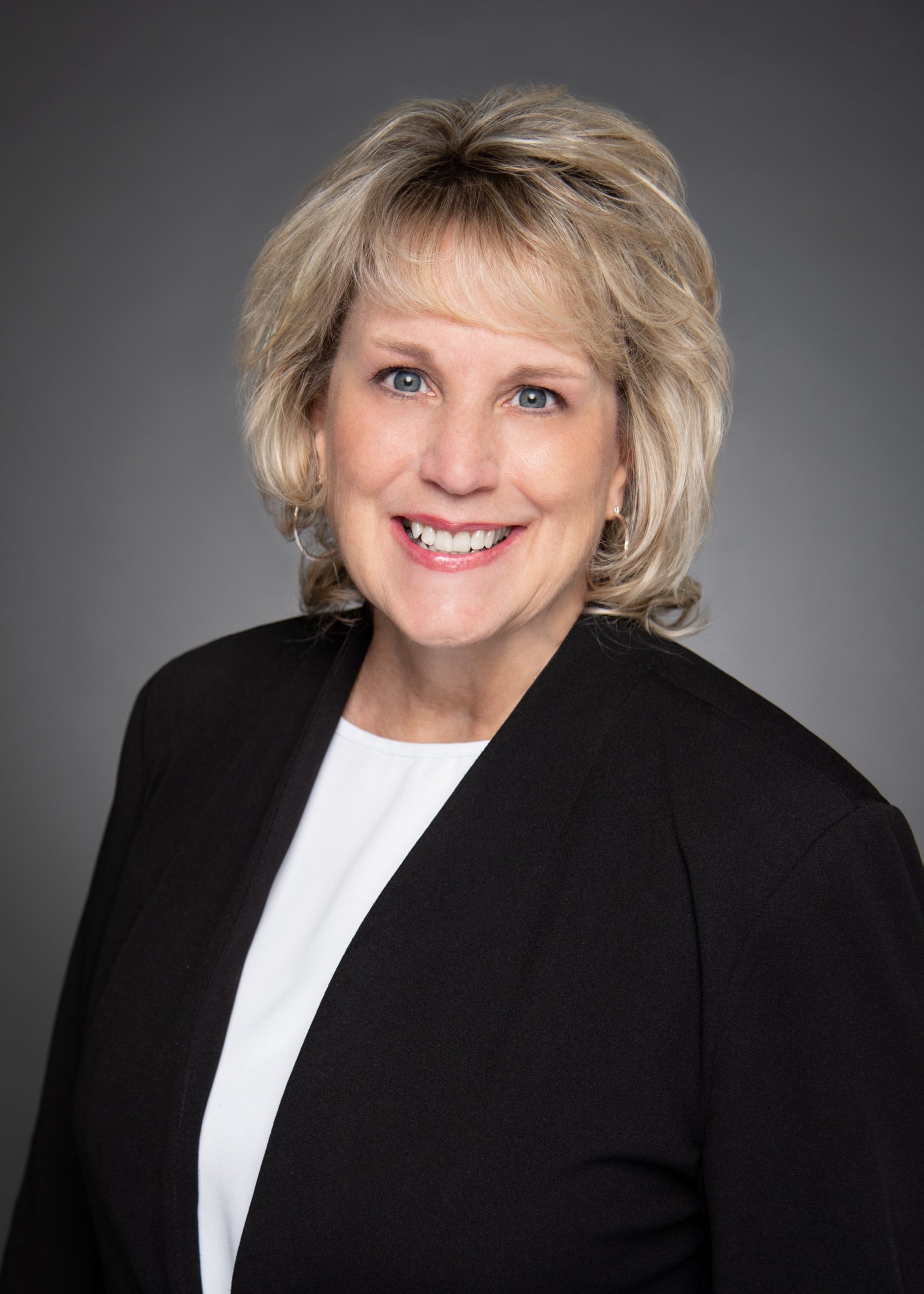
Leadership today rarely lives at the extremes. It exists in the in-between. Between generations, between old expectations and new realities, between the pressure to perform and the responsibility to care for people. In this Marshall Jones Leadership Spotlight, we sit with Diane, a senior tax leader at Marshall Jones, whose career spans public accounting, corporate finance at scale, and nearly seven years inside a firm intentionally redefining what independence and leadership can look like.
Diane’s perspective is shaped by range. Earlier in her career, she served as a VP of Finance at SAP America, overseeing financial operations across offices nationwide. That experience gave her a systems-level view of how organizations work — and where they break. When she transitioned more fully into public accounting and advisory work, she found herself energized not by compliance alone, but by helping clients make better decisions in real time.
“Historical data is what it is,” she explains. “What matters is how you use it to move forward.” That mindset continues to define her work today. Taxes may intimidate clients, but Diane sees solvable problems, human stories, and opportunities for clarity. The fear, she notes, often comes from silence. The unopened letters, unanswered questions, delayed action. Leadership, in her view, starts by engaging reality head-on.
Choosing Independence and Change
Marshall Jones has long been a respected, independent firm, and Diane has seen firsthand what it means to preserve that independence while still evolving. For much of her tenure, change was incremental. Over the past year, however, something shifted.
By joining the leadership team more closely, Diane witnessed a deliberate effort to rethink legacy itself. Rather than defaulting to tradition, firm leadership committed to defining who they want to become next. Implementing EOS and Traction was not about adopting buzzwords, but about creating shared language, accountability, and intention.
What stood out most to Diane was the authenticity of the process. Core values were not handed down — they were debated, pressure-tested, and meant. “You can feel the difference when values aren’t just words on a wall,” she says. “When leadership actually lives with them, people notice.”
That visibility matters, especially in moments of tension. Culture, Diane observes, is fragile when buy-in is uneven. When senior leaders don’t model alignment, teams feel it immediately. For Diane, one of the ongoing challenges within her own group is ensuring that values are not just stated, but consistently reinforced through action.
Leading Across Generations Without a Playbook
Perhaps the most complex leadership terrain Diane navigates is generational. With a team that spans decades of experience, she operates at the intersection of very different expectations about work, authority, and balance.
Earlier in her career, competition was fierce and loyalty assumed. You stayed, you learned on your own, and you earned your way forward. Today’s workforce brings different strengths… and different assumptions. Flexibility is expected. Teaching is demanded. Boundaries are non-negotiable.
Diane does not dismiss these shifts, but she is candid about the strain they can create. Managing across generations requires constant translation. What motivates one group may alienate another. What feels like commitment to some can look like burnout to others.
Remote work has only amplified these tensions. While flexibility has real value, Diane is clear that working from home is still working. Expectations do not disappear simply because location changes. Communicating those expectations clearly, repeatedly, and fairly has become one of the hardest parts of leadership.
There is no single book or framework that solves this. Diane pulls as much from lived experience as from formal leadership models. She acknowledges her own learning curve, including the need to model healthier balance herself. “If all people see is me working all the time,” she says, “why would they want to grow here?”
Rethinking Balance Without Losing Standards
Work-life balance is not a slogan for Diane; it is a discipline. One she admits she has not fully mastered. With client demands, constant connectivity, and a career built on availability, stepping back is harder than it sounds.
Her global experience adds perspective. At SAP, entire regions shut down for August… and the business still thrived. The lesson was not about working less, but about trusting systems, planning ahead, and valuing rest as a performance strategy, not a reward.
Diane is now asking harder questions of herself and her team. What would it look like to plan for real time off? What standards need to be met to make that possible? How do you respect flexibility without eroding accountability?
These are not theoretical questions.
They go to the heart of sustainability — of careers, of teams, and of firms like Marshall Jones that want to endure without losing their humanity.
Leadership as Continuity, Not Exit
As conversations across industries increasingly focus on “making room for the next generation,” Diane offers a grounded counterpoint. Experience is not an obstacle to progress — it is often the engine of it. Mentorship, institutional knowledge, and the willingness to share mistakes are essential bridges between where organizations have been and where they are going.
One of her earliest mentors taught her a simple rule: pass down what you learned the hard way. That obligation now shapes how Diane leads. She believes Marshall Jones is uniquely positioned to honor that continuity while still inviting new ideas, new voices, and new ways of working.
Leadership, in the end, is not about choosing between past and future. It is about holding both. And doing the work required to connect them.